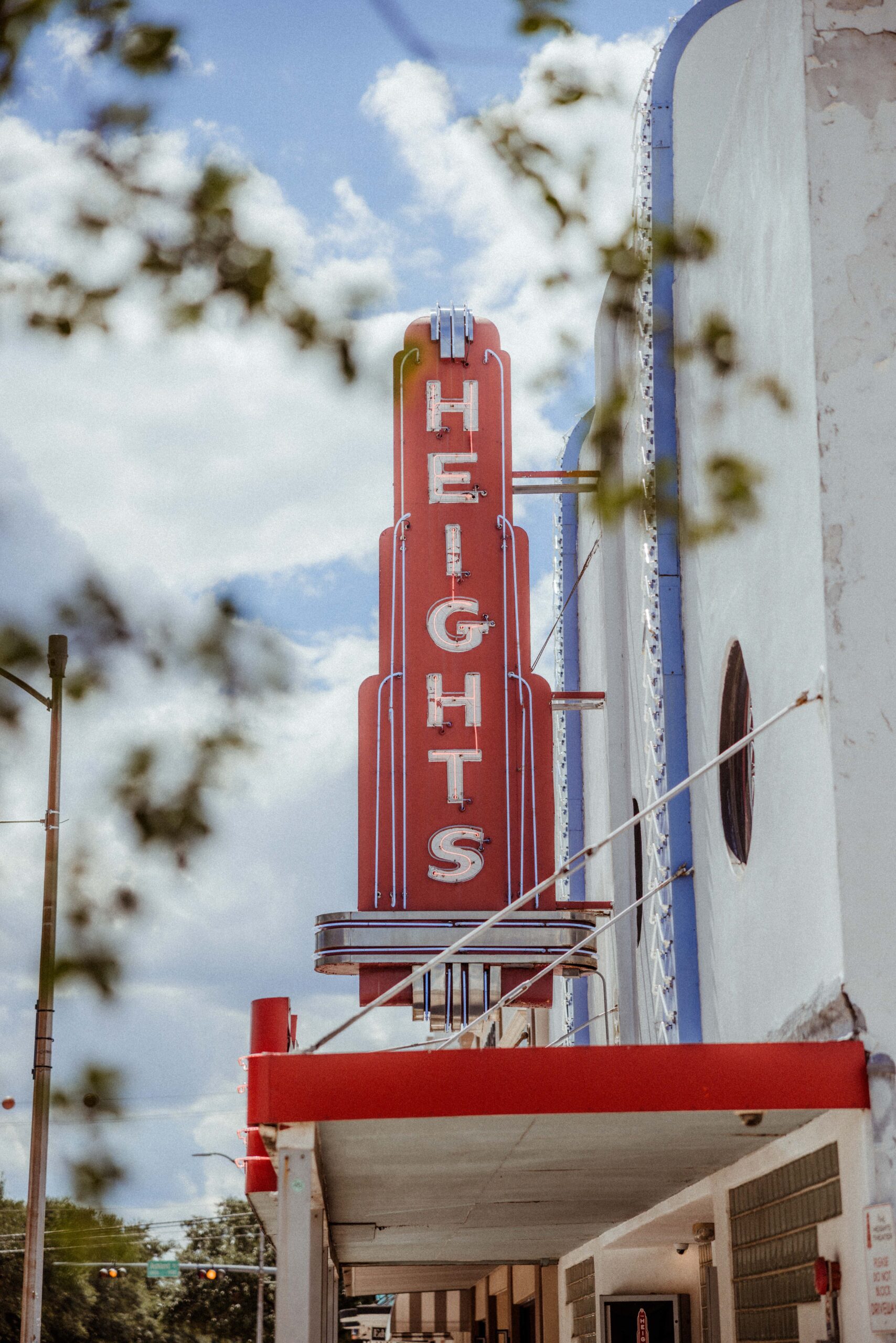
We’re heading to Houston next week on a work trip for my husband and now it’s got me daydreaming of all the stunning areas the city holds. While it’s nearly impossible to see everything in one visit, concentrating on one neighborhood at a time is a must-do! I’ve put together a special Houston Heights 2-Day “slowdown” itinerary, giving you all the visuals to make you feel like you’re already there! Enjoy!


You’re waking up at Hotel Daphne to the soft hum of the Heights. The city is out there somewhere—glass towers, freeways, and oil-town lore—but up here, in this leafy neighborhood of century-old bungalows and crepe myrtles, Houston feels intimate. Hotel Daphne was built for that feeling.
Tucked into the Heights, the hotel leans into Bunkhouse’s signature style: layered vintage furniture, warm wood, textiles that feel collected, and public spaces that invite you to linger instead of rush. The lobby is more living room than check-in zone—think books and art, light filtering in from the courtyard, and the faint clink of glassware from the bar as staff move in an easy rhythm around you. The Heights itself is a walkable grid of tree-lined streets and porches, where tiny corner cafes and low-rise restaurants share the block with old houses and indie shops. It’s the perfect base for a two-day, slow-travel Houston story.

Day One: Heights, History, and a Sunset of Color
Your first morning starts downstairs, not out on the street of Houston Heights. Hotel Daphne’s all-day restaurant and bar spill out toward an inner courtyard, so you can have breakfast in a space that feels part café, part neighborhood hangout. Expect thoughtful coffee, a breakfast menu that nods to Texas produce, and guests who are clearly here to savor the setting as much as the city beyond. This is where you settle in, notice the tiles, the light, the way the property opens onto greenery, and quietly sketch the tone of your trip: deliberate, design-conscious, unhurried.
From there, Houston Heights is entirely at your feet. Walk north toward 19th Street, one of the neighborhood’s main spines, and you’ll feel how quickly Houston’s scale shrinks down to something human. The storefronts are low and eclectic: vintage shops with racks of Western shirts and 70s dresses, bookstores with handwritten staff picks, art and curiosity shops that feel like extensions of people’s living rooms. Between them, you’ll dip into bakeries and coffee houses—Boomtown Coffee is a local favorite for pour-overs and espresso in a warm, brick-walled space, an easy place to watch Heights regulars stream in and out.
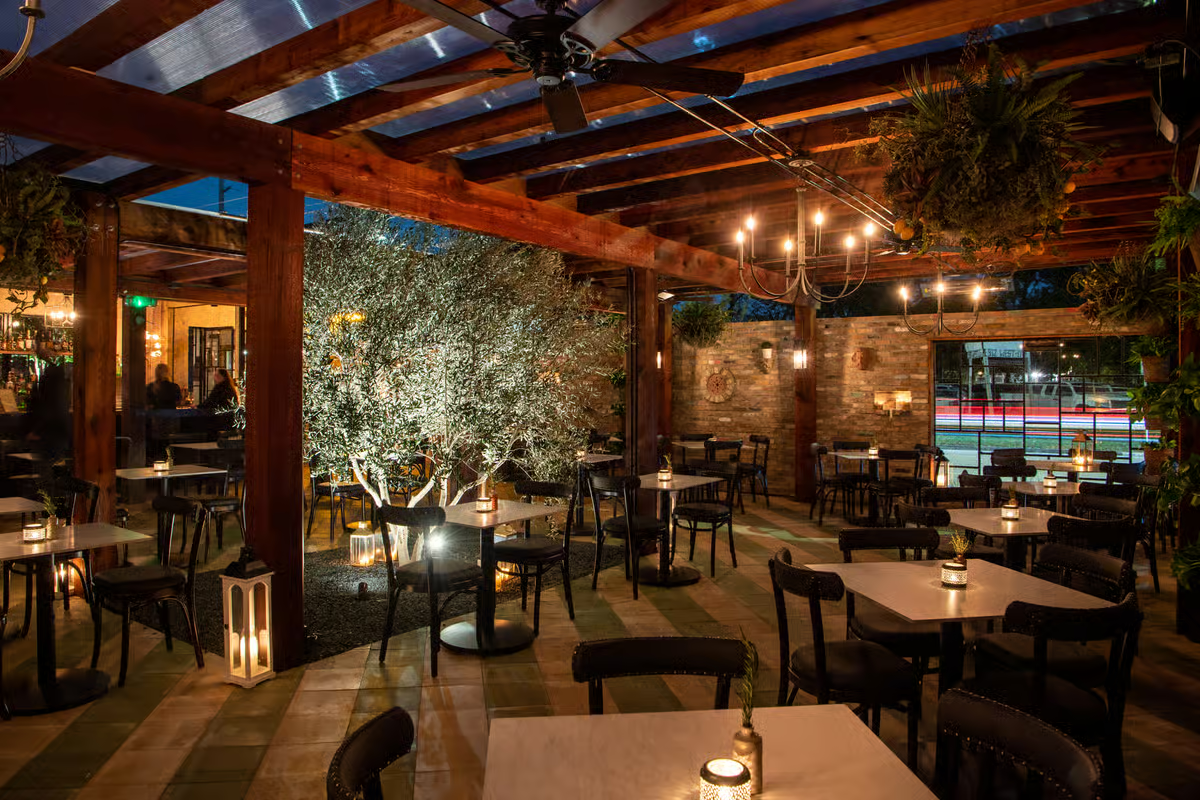
By lunchtime, you’re only a short stroll or rideshare away from two very different ways to eat the neighborhood. Trattoria Sofia leans into a cinematic version of Italian: tucked-away courtyard tables, string lights, lush greenery, and plates of handmade pasta and wood-fired pizza that arrive in generous, shareable portions. It’s the kind of place where lunch can quietly stretch toward late afternoon because the patio feels like a world of its own. A few blocks away, La Lucha channels retro Gulf Coast energy with fried chicken, oysters, and seafood platters under big shade trees and neon glow. Its vibe is rowdier, louder—a little bit of New Orleans, a little bit of old Texas—a perfect reflection of Houston’s coastal personality.
The afternoon is about letting the Heights show its rhythm. Rent a bike or simply walk the Heights Hike and Bike Trail, an elevated greenway that cuts through the neighborhood and gives you glimpses of backyards, gardens, and the occasional mural. The trail folds into Heights Boulevard, where a grassy esplanade hosts rotating public art and walkers of all ages moving at different paces. You could spend an hour or two here, dipping off the trail into side streets to admire restored Craftsman homes, or circling back to Hotel Daphne for a quiet hour in the library or courtyard, a drink in hand and the low buzz of hotel life around you.
As the sun starts to soften, Houston pulls you gently out of the Heights and into something more surreal. A short drive takes you to Rice University, where James Turrell’s “Twilight Epiphany” Skyspace sits partially submerged into the lawn like a geometric secret. You arrive 20–30 minutes before sunset, climb the low steps, and join the small crowd settling onto tiered benches under a wide rectangular aperture in the ceiling. As the sky darkens, the LED light program begins, shifting the color of the ceiling and the open sky in calibrated sequences—pale blues to hot pinks to deep violets—until you’re not entirely sure what’s natural and what’s engineered. The atmosphere is hushed, contemplative; phones soften, voices drop, and the city feels far away.
After the Skyspace, the energy flips again in Rice Village, a bustling neighborhood with tree-lined streets and a mix of boutiques, bars, and restaurants. Coppa Osteria becomes your dinner stop: a lively Italian spot where the bar is busy, the open kitchen flickers with heat, and pizzas land on tables alongside bowls of handmade pasta and smartly curated wines. If you want something more intimate, you can pivot to a place like BCN Taste & Tradition, but Coppa’s easygoing enthusiasm captures Houston’s love of good food without pretense. Later, back in the Heights, the quiet streets and Hotel Daphne’s soft lighting feel like a gentle exhale.

Day Two: Bayou Mysteries and Folk-Art Marvels
Day two begins once again with Hotel Daphne’s calm as a backdrop: a slow breakfast, a second coffee, maybe a few notes typed from a courtyard table. Then it’s time to see the Houston most visitors barely touch—the wild edge where nature, infrastructure, and art collide. Buffalo Bayou Park runs like a green artery just west of Downtown, a network of trails, gardens, and overlooks that follow the water’s curve. Depending on your mood, you can rent a bike, walk the paved paths, or simply wander from overlook to overlook, watching kayakers slide past and downtown’s skyline rearrange itself with every turn.
Hidden beneath this calm landscape is the Buffalo Bayou Park Cistern, a decommissioned city water reservoir turned art and light venue. You descend via a staircase into cool, dim air, stepping onto an elevated walkway that snakes through a vast forest of concrete columns rising from a shallow pool of water. The still, reflective surface mirrors the columns, multiplying them into infinity and turning the space into something between a cathedral and a ruin. Sound—footsteps, whispered conversations—echoes in unexpected ways. Occasionally, special art or light installations transform the space further, but even at its simplest, it’s a singular experience: a reminder that underneath the city’s surface, whole worlds lie hidden.

Emerging back to daylight, you’re ready for lunch. Flora, perched above the bayou, feels almost like a treehouse—walls of glass framing the green park and skyline beyond, plus a lush interior of plants and warm textures. The menu leans modern Mexican: bright ceviches, grilled meats, thoughtfully executed classics, and cocktails that play off Latin American flavors. Alternatively, you can steer toward something more casual along the Washington Avenue corridor or build a picnic with provisions from the Heights and spread out on the bayou lawn.

The afternoon is reserved for Houston’s stranger side. The Beer Can House looks, at first, like a regular bungalow—until you’re close enough to see that the siding, fences, and even wind chimes are made of flattened, folded, and strung beer cans. Begun in the late 1960s by John Milkovisch, the project started as a thrifty way to reuse cans and became a full-scale folk-art environment, shimmering in the Texas sun. It’s oddly beautiful, deeply personal, and makes for photos that feel nothing like typical Houston postcards.

From there, you make your way to Smither Park, an evolving folk-art park where local artists cover walls, benches, arches, and a small amphitheater in mosaics made from broken ceramics, glass, and found objects. No two sections are alike—there are abstract patterns, narrative scenes, and whimsical creatures, often with small details that reward slow looking. Because artists continue to add to the park over time, it has the feeling of a living sketchbook, constantly in process. This is the Houston that carries its creativity in backyards and community spaces, not just in traditional museums.
As the day winds down, you head back to the Heights, where dinner brings the focus back to neighborhood warmth. Rainbow Lodge sits in a historic log cabin on a bayou bank, surrounded by greenery that makes you momentarily forget you’re in the fourth-largest city in the country. Inside, the atmosphere is woodsy and refined—stone fireplaces, hunting-lodge touches—while the menu highlights Gulf seafood and wild game in dishes that still feel contemporary. It’s the kind of place where a long, candlelit meal makes sense after a day of exploration. If you’re feeling like something more modern, you can opt for a spot like JŪN in the Heights, where chef-driven, globally inflected dishes come out of a sleek open kitchen into a humming dining room.

Your final evening brings you back through the quiet streets to Hotel Daphne. The neighborhood is restful now—porch lights on, dogs out for final walks, a faint murmur from a nearby bar. Inside, Daphne’s common spaces glow: maybe you slip into the bar for a nightcap, or choose a chair in the library to reflect on the past days. Two days in Houston, rooted in one small hotel in the Heights, have given you something most itineraries skip: a sense of scale, of texture, of how the city breathes. It’s not the Houston of glossy brochures and convention centers. It’s the Houston of quiet side streets, hidden underground cathedrals, and folk-art visions—and a boutique hotel that makes you feel, at least for a couple of days, like you live here.
I hope you loved the Houston Heights 2-Day Itinerary! Have you visited any of these spots? I’d love to hear what you thought.
As always, happy traveling! -B
Leave a Reply